Santa Fe Chamber Music Festival

Tuesdays at 7pm through August 18
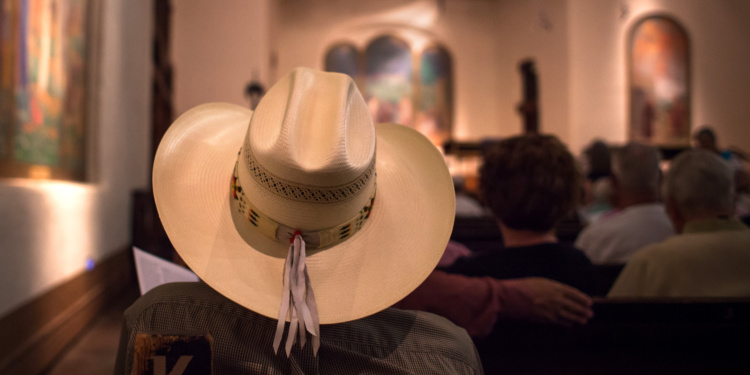
SFCMF2024_Man-in-hat_From-back-of-St-Francis_(Photo-by-Mark-Holm)

Photo: Mark Holm

The 2026–27 Santa Fe Chamber Music Festival radio series brings you a rich mix of beautifully recorded performances from the Festival’s 2025 summer season. Each program features two or three complete works, showcasing the depth and variety of the chamber music repertoire. You’ll hear everything from beloved masterworks to compelling discoveries by lesser-known composers.

SFCMF Stacked Logo-180x138px

2026 Schedule

  • July 7

    Stellar pianist Kirill Gerstein opens this Santa Fe Chamber Music Festival broadcast with a new work called Two Waltzes Toward Civilization, which the award-winning Spanish composer Francisco Coll wrote especially for him. After the Coll, we have a piece Schubert composed for what was, in 1824, a brand-new instrument. Today, the arpeggione – a kind of cross between a cello and guitar – is virtually unknown. Schubert’s Sonata for Arpeggione & Piano in A Minor, however, remains one of the most lyrical and tranquil pieces in the repertoire. Today, this piece is often played on the cello, and we will hear a gorgeous performance by cellist Paul Watkins and pianist Ran Dank. Closing the hour, we have the Dover Quartet and their riveting interpretation of Dvorák’s quintessential Czech take on American, the melodious String Quartet in F Major.

    FRANCISCO COLL

    Two Waltzes Toward Civilization after Lorca’s Poet in New York) (2024)
    Waltz in the Branches
    Little Viennese Waltz
    Kirill Gerstein, piano

    W.A. MOZART

    Sonata in F Major for Violin and Piano, K. 376 (1781)
    Allegro
    Andante
    Rondo: Allegretto grazioso
    Paul Huang, violin and Orion Weiss, piano

    ANTONÍN DVORÁK

    String Quartet in F Major, Op. 96, American (1893)
    Allegro ma non troppo
    Lento
    Scherzo
    Finale: Vivace ma non troppo
    Dover Quartet (Joel Link, Bryan Lee, violin; Hezekiah Leung, viola; Camden Shaw, cello)

  • July 14

    This wide-ranging program brings together two very distinctive trios for horn, violin, and piano. Each expresses archetypal music from two very different yet important and idiosyncratic composers. In both pieces, we have exceptional performances from the Berlin Philharmonic’s principal horn, Stefan Dohr, the American violinist William Hagen, and the magnificent pianist Kirill Gerstein. Gerstein brings out the lyrical aspects in Ligeti’s singular trio, which the composer wrote in 1982 and intended as an Hommage à Brahms. Later, these dazzling collaborators perform Brahms’s wonderful 1865 horn trio, a pastoral, soothing work, which Brahms wrote after the death of his mother, and which provides grace for the living in a time of mourning.

    GYÖRGY LIGETI

    Trio for Horn, Violin and Piano, Hommage à Brahms (1982)
    Andantino con tenerezza
    Vivacissimo molto ritmico
    Alla Marcia
    Lamento. Adagio
    Stefan Dohr, French horn; William Hagen, violin; Kirill Gerstein, piano

    JOHANNES BRAHMS

    Horn Trio in E-flat Major, Op. 40 (1865)
    Andante
    Scherzo: Allegro
    Adagio mesto
    Finale: Allegro con brio
    Stefan Dohr, French horn; William Hagen, violin; Kirill Gerstein, piano

  • July 21

    The tradition of using music to accompany banquets and feasts is probably as old as music itself, but that didn’t limit Telemann to composing musical wallpaper. On the contrary, Telemann’s Quartet in G Major from Tafelmusik is spirited, bright, and brilliantly crafted. To oboist Frank Rosenwein, “Telemann is like Bach – an incredible watchmaker. He can create really intricate structures within this music, and his genius is that it comes off as very easy to listen to.” Following the Telemann, pianist Katia Skanavi, violinist William Hagen, violist Hezekiah Leung, and cellist Mihai Marica perform Dvořák’s sweeping, orchestral-like Piano Quartet in E-flat Major.

    GEORG PHILIPP TELEMANN

    Quartet in G Major from Tafelmusik, TWV 43:G2 (1733)
    Largo – Allegro – Largo
    Vivace – Moderato – Vivace
    Grave
    Vivace
    Tara Helen O’Connor, flute; Frank Rosenwein, oboe; Daniel Phillips, violin; Felix Fan, cello; Paolo Bordignon, harpsichord

    ANTONÍN DVORÁK

    Piano Quartet in E-flat Major, Op. 87 (1889)
    Allegro con fuoco
    Lento
    Allegro moderato, grazioso
    Finale: Allegro ma non troppo
    Katia Skanavi, piano; William Hagen, violin; Hezekiah Leung, viola; Mihai Marica, cello

  • July 28

    Week 10 of the Santa Fe Chamber Music Festival’s 2026 radio series begins as Chad Hoopes and the Dover Quartet’s second violinist, Bryan Lee, play one of Bach’s most cherished works: the incomparable Concerto in D Minor for Two Violins, known as the “Bach Double.” Soprano Liv Redpath and her frequent collaborator, pianist George Fu, perform a pair of youthful songs by Debussy. The hour concludes with one of those rarely performed pieces the Santa Fe Chamber Music Festival is known for. The musician, composer, and pedagogue Frank Bridge began in the pastoral English sound world and evolved into what Festival artistic director Marc Neikrug calls “his own true voice, his own world.” Pianist Orion Weiss, violinist Jennifer Frautschi, and cellist Felix Fan give a breathtaking performance of Bridge’s gnarly and brilliant 1929 Piano Trio No. 2.

    JOHANN SEBASTIAN BACH

    Concerto in D Minor for Two Violins, BWV 1043 (1720)
    Vivace
    Largo, ma non tanto
    Allegro
    Violinists Chad Hoopes and Bryan Lee, soloists; with an ensemble of Santa Fe Opera Orchestra musicians, led by Daniel Jordan as concertmaster.

    CLAUDE DEBUSSY

    “Jane” (1881) & “Romance: Silence ineffable” (1883)
    Liv Redpath, soprano; George Fu, piano

    FRANK BRIDGE

    Piano Trio No. 2, H. 178 (1929)
    Allegretto ben moderato—
    Molto allegro
    Andante molto moderato—
    Allegro ma non troppo
    Orion Weiss, piano; Jennifer Frautschi, violin; Felix Fan, cello

  • August 4

    Week 11 features two very different early 20th century works, with composers expressing themselves in two very different means. In Ravel’s 1921 Sonata for Violin and Cello, two melodic instruments explore their mutual and individualistic sonorities. Violinist Leila Josefowicz and cellist Paul Watkins join forces in performing Ravel’s entrancing composition, which he wrote in the aftermath of World War I and dedicated in memory of Debussy. Dohnányi’s stunningly inventive and heroic Sextet, performed by an ensemble of Festival musicians that includes clarinetist David Shifrin and Berlin Philharmonic principal horn Stefan Dohr, brings the program to a dramatic close.

    MAURICE RAVEL

    Sonata for Violin and Cello, M. 73 (1920-22)
    Allegro
    Scherzo: Très vif
    Lent
    Vif, avec entrain
    Leila Josefowicz, violin; Paul Watkins, cello

    ERNST VON DOHNÁNYI

    Sextet in C major for Clarinet, Horn, Violin, Viola, Cello, and Piano, Op. 37 (1935)
    Allegro appassionato
    Intermezzo: Adagio
    Allegro con sentiment
    Finale: Allegro vivace, giocoso
    David Shifrin, clarinet; Stefan Dohr, horn; Jennifer Frautschi, violin; Toby Appel, viola; Eric Kim, cello; Soyeon Kate Lee, piano

  • August 11

    Pairing a baroque-era gem with two late works by Mendelssohn, Week 12 begins with stunning music that isn’t heard often enough: a Trio Sonata composed around 1745 by Bach’s contemporary, Giovanni Benedetto Platti. Platti expands the cello’s role from bass line to a more singing, melodic role, much to the delight of cellist Felix Fan, who enjoyed the “soloistic phrases” and the opportunity to have “a conversation” with oboist Frank Rosenwein. The brilliant and lyrical harpsichord player, Paolo Bordignon, rounds out the ensemble. Rocked by the loss of his sister Fanny, Felix Mendelssohn began one of the last chamber works he would ever write before his own demise, at the age of 38. The Escher String Quartet performs the two movements of Mendelssohn’s Opus 81 Andante and Scherzo with pathos, sensitivity and depth. Mendelssohn wrote his second and final piano trio in April 1845. Masterful, idiomatic writing drives the epic Trio in C Minor, and here it is played with great virtuosity by Gilles Vonsattel, piano; Yura Lee, violin; Mark Kosower, cello.

    GIOVANNI BENEDETTO PLATTI

    Trio Sonata in G Minor (c. 1745)
    Adagio
    Allegro
    Adagio
    Allegro
    Frank Rosenwein, oboe; Felix Fan, cello; Paolo Bordignon, harpsichord

    FELIX MENDELSSOHN

    Andante and Scherzo for String Quartet, Op. 81
    Escher String Quartet (Adam Barnett-Hart, James Thompson, violin; Pierre Lapointe, viola; Brook Speltz, cello)

    FELIX MENDELSSOHN

    Trio in C Minor, Op. 66 (1845)
    Allegro energico e con fuoco
    Andante espressivo
    Scherzo: Molto allegro quasi presto
    Finale: Allegro appassionato
    Gilles Vonsattel, piano; Yura Lee, violin; Mark Kosower, cello

  • August 18

    The culminating episode holds a masterwork by Brahms and an emotionally powerful song by Schubert. To begin, soprano Liv Redpath sings “Ganymed,” which Schubert based on a poem of the same name by Goethe. The poem tells the story of a handsome youth who’s taken up to heaven on the back of an eagle to become a cupbearer for the gods. Mature music of Brahms brings this 2026 season of performances from the Santa Fe Chamber Music Festival to a close. Brahms stretches the parameters of the classical form in his Opus 26 Piano Quartet in A Major, a work Festival artistic director Marc Neikrug describes as “beyond beautiful, beyond sumptuous, beyond rich.” For this performance, Neikrug brings together a sublime group of collaborators: pianist Kirill Gerstein, violinist Joel Link, violist Toby Appel, and cellist Camden Shaw.

    FRANZ SCHUBERT

    “Ganymed,” D. 544 (1817)
    Liv Redpath, soprano; George Fu, piano

    JOHANNES BRAHMS

    Piano Quartet in A Major, Op. 26 (1861-62)
    Allegro non troppo
    Poco adagio
    Scherzo: Poco allegro
    Finale: Allegro
    Kirill Gerstein, piano; Joel Link, violin; Toby Appel, viola; Camden Shaw, cello